
The Quarter in Review | 2Q 2026
A HISTORIC REBOUND AS THE FED CHANGES HANDS
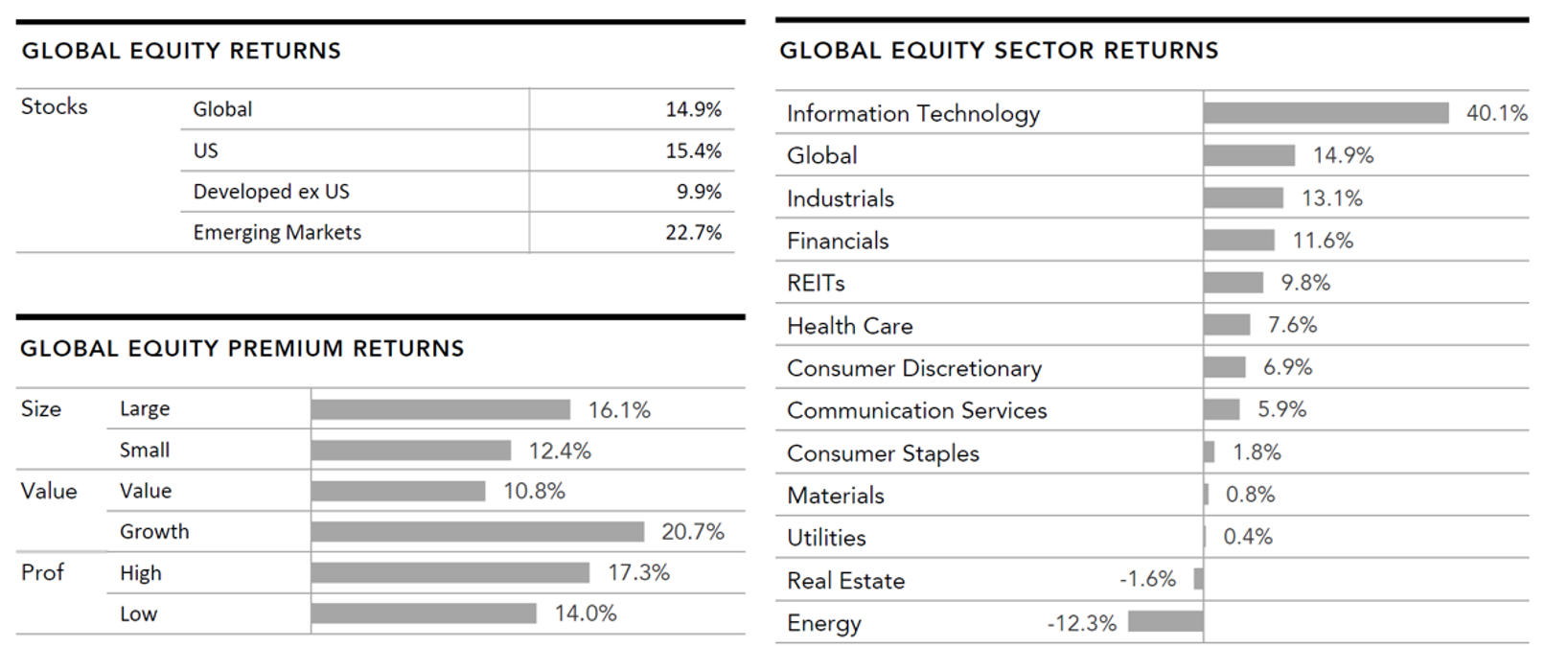
What a difference a quarter makes. Three months ago, oil was near $100 a barrel, headlines were dominated by war, and stocks were coming off their worst start to a year since 2022. Then diplomacy took hold, a mid-June ceasefire with Iran reopened shipping through the Strait of Hormuz, and the Russell 3000 Index returned +15.4% for the quarter. The S&P 500 closed above 7,000 in April for its first record since January, and both the S&P 500 and the Nasdaq finished on pace for their best quarter in six years.
Technology led the charge. Semiconductor stocks, the picks and shovels of the artificial intelligence buildout, posted a record quarterly gain of roughly +88%, memory-chip maker Micron rode a year-long surge into the ranks of the 10 largest U.S. companies, and SpaceX raised $75 billion in the largest IPO in history. But the rally ran well beyond the familiar names. Small caps returned +21.5%, capping their best first half since 1991, and while growth stocks edged value for the quarter, value still holds a wide lead for the year, with the Magnificent 7 equal-weight performance actually in the red for 2026.
Emerging markets delivered the quarter's biggest gains, rising +22.7% behind Korea and Taiwan and their central role in chip manufacturing, and were the only major region to outpace the U.S. International developed stocks, which returned a healthy +9.9% but trailed the American market.
FIXED INCOME
The quarter brought a changing of the guard at the Federal Reserve. Kevin Warsh was sworn in as the Fed's 17th Chairman in May, and at his first meeting in June the committee held the federal funds rate steady at 3.5% to 3.75%. The style change was as notable as the decision: the policy statement was cut to a fraction of its former length, closing simply with a pledge to deliver price stability. Warsh, a longtime skeptic of forward guidance, declined to submit his own rate projection. Markets got the message anyway. In January, consensus called for two rate cuts in 2026. By the end of June, the bond market had priced in two rate hikes instead.
The 10-year Treasury yield took a violent round trip, climbing toward 4.6% in mid-May (the 30-year briefly topped 5% for the first time since 2007) before settling at 4.44% as oil collapsed. Rising yields pressured bond prices (which fall when rates rise), but today's healthier income cushioned the blow. The U.S. Aggregate Bond index returned +0.67% for the quarter and is up +3.79% over the last year, while high-yield corporate bonds gained +2.5%.
ALTERNATIVES
Commodities gave back much of their first-quarter surge as the ceasefire drained the war premium from energy and metals. Silver and WTI Crude Oil were the worst performers, returning -20.5% and -19.1% for the quarter, with oil prices falling all the way back to pre-conflict levels. Gold, often held as a crisis hedge, declined -13.5% in a quarter that featured an active war, including its largest single-month drop since 1975. Overall, the Bloomberg Commodity Total Return Index returned -8.1% for the quarter but remains up +14.4% year-to-date. U.S. Real Estate Investment Trusts (REITs) fared far better, up +12.4% for the quarter and +22.6% over the last 12 months.
ECONOMY
The economy absorbed shocks that were supposed to derail it. Hiring stayed firm through the quarter, with roughly 178,000 jobs added in March, 115,000 in April, and 129,000 in May extended the streak, while unemployment held near 4.3%. Corporate America did the heavy lifting: second-quarter earnings grew more than 20% year-over-year, a seventh consecutive quarter of double-digit growth, on the strongest revenue growth since 2022.
Beneath those numbers, the economy's center of gravity is shifting. Growth is being driven less by the consumer and more by corporate investment in chips, power, and data centers, an AI buildout that has proven larger and longer-lasting than most expected. That strength cuts both ways: it supports earnings, but it also feeds inflation, the economy's sore spot. The Consumer Price Index reached 4.2% in May, its highest since 2023, though core inflation held near 2.9%, shelter costs continue to cool, and productivity is running well above its 15-year trend.
A RECORD IPO AND A REOPENED MARKET
After several lean years, the market for new stock listings reopened this quarter in record fashion. SpaceX priced its June debut at $135 per share, raising $75 billion at a valuation near $1.8 trillion, the largest IPO in history and roughly two-and-a-half times the record Saudi Aramco set in 2019. More is coming: OpenAI and Anthropic are reportedly preparing their own listings, and by some estimates the three companies combined could raise nearly $200 billion, more than every U.S. IPO from 2022 through early 2026 put together.
We will be honest about our reluctance here. SpaceX came public at nearly 90 times its expected annual revenue, and OpenAI's latest private valuation works out to more than 30 times revenue. Compare that with the companies already collecting AI's profits: Nvidia, the dominant chipmaker of the buildout, trades near 23 times next year's expected earnings, and Alphabet, whose AI models sit alongside a famously profitable search business, trades at 25x forward earnings, both within shouting distance of the broad market's roughly 20x multiple. The newcomers are priced on revenue they hope to someday turn into profits while the incumbents are priced on profits they already make. That is quite a premium for promise over proof.
None of this requires action, and that is the point. With index providers moving to fast track mega-cap listings into the major benchmarks, investors who own the broad market will hold these new names within weeks of their debuts, at their market weight, without paying up on opening day. There is no need to chase what your portfolio will soon deliver on its own.
LOOKING FORWARD
The second half arrives with real question marks: whether the Fed follows through on hikes, whether the ceasefire with Iran holds (as of this writing, we’re seeing a breach in the ceasefire as tensions and rhetoric escalate), and what happens when the current tariff framework expires in late July with new tariffs promised behind it. We hold our usual position on predictions, and this year has been the best argument for it in memory. The January consensus called for rate cuts; we got hike expectations. The March consensus was fear; anyone who sold then missed one of the strongest quarters in a generation.
History adds one more perspective. 2026 is a midterm election year, and midterm years have historically been among the most volatile of the four-year political cycle. Yet since 1950, U.S. stocks have been higher in the 12 months following every single midterm election, under both parties and every combination of them. We plan for what might happen rather than trying to predict what will.
While short-term market movements remain unpredictable, especially with inflation and the rate path unsettled, maintaining discipline and focus on long-term objectives continues to be a reliable approach to investment success. During these times, commitment to disciplined investment management becomes even more important.
SUMMARY
The strong finish should not obscure how bumpy the ride was. Consider this:
June 5 saw the S&P 500 fall 2.63% in a single day, one of its worst daily returns of the past 30 years, inside a quarter that ended near record highs.
The bumps and the gains arrived together, as they usually do.
Perhaps more so than in recent memory, the road ahead appears more ambiguous and tumultuous than ever. Thankfully, none of us are traveling this road alone. Uncertainty, tumult, rebounds, gains: they are all part of the investor's journey. And, like every quarter, we'll say it again because it bears repeating: this is where time we spend with you up front in developing your investment plan pays dividends in the long run.
We appreciate the opportunity to work with each of you. We recognize that each client’s situation is unique and incorporates different factors into their investment and financial plan.
As always, if you have any questions or concerns about current market trends and the impact on your personal situation and plan, please contact us and we would be happy to discuss with you.
Please follow this link to read the complete QMR Q2 2026.