
A RECORD-HIGH MARKET MEETS THE FED'S FIRST HIKE IN YEARS
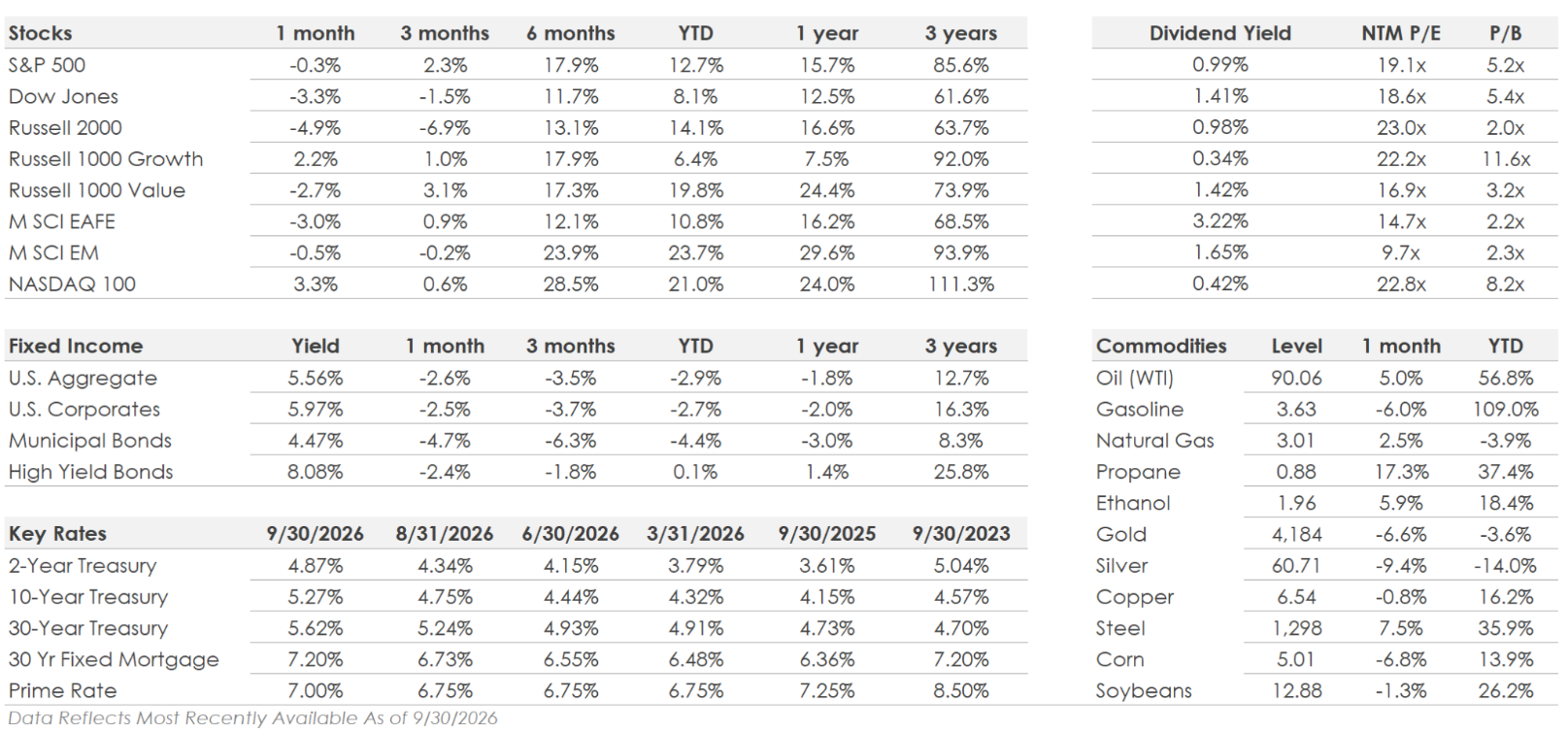
The bill for a resilient economy came due this quarter. Oil, which collapsed after June's ceasefire, reversed course and climbed back above $100 a barrel as fighting with Iran resumed, inflation refused to settle, and in September the Federal Reserve raised interest rates for the first time in more than three years. Stocks absorbed it all surprisingly well, at least on the surface: the Russell 3000 Index returned +1.4% for the quarter, the S&P 500 set a new all-time high in August, and the U.S. finished ahead of both international developed and emerging markets.\
Look beneath the surface, though, and this was a market sorted by interest rates. Energy, dead last a quarter ago, led everything with a +17.2% gain as oil made a round trip from roughly $70 back above $100. Technology added +7.2% on the strength of the artificial intelligence buildout, while the rate-sensitive corners of the market (utilities, industrials, and real estate) all fell. The sharpest reversal came in small caps: they entered July riding their biggest run in decades and finished the quarter down 7.2%, as smaller companies feel higher borrowing costs first. Value stocks, meanwhile, quietly extended their lead for the year over the market's most celebrated growth names.
Overseas, markets caught their breath after a strong first half. International developed stocks added +1.2% and emerging markets slipped 0.3%, but the year-to-date scoreboard still belongs to the rest of the world: emerging markets remain up +22.0% in 2026, the best of any major region. The quarter even produced a currency milestone, with the U.S. and Japan intervening together to support the yen for the first time since 1998.
FIXED INCOME
The hike the bond market spent all spring pricing in finally arrived. At Kevin Warsh's third meeting as Chairman, the Fed raised the federal funds rate a quarter point in September to a range of 3.75% to 4.00%, the first increase since 2023, and this time the vote was unanimous after three officials had pushed for a hike back in July. The committee's own projections call for one more increase before year-end, though the market, as it has all year, keeps changing its mind: after a weak September jobs report, the odds of an October move faded fast.
Treasury yields did most of the damage before the Fed ever acted. The 10-year yield climbed 85 basis points to 5.29%, crossing 5% in mid-September, a level Wall Street greeted as the start of a new era. Rising yields push down the prices of existing bonds (the two always move in opposite directions), and this quarter not even today's healthier income could cushion a move of that size. The U.S. Aggregate Bond Index returned -3.51% for the quarter and has returned -1.84% over the last year, while high-yield corporate bonds held up better at -1.8%. That resilience carries its own caution: bond yields now sit near the top of their 20-year range, while the extra compensation for taking credit risk sits near the bottom of it. Investors are finally being paid well to lend, just not paid much extra to lend to riskier borrowers, and that math argues for quality over reaching for yield.
ALTERNATIVES
Commodities were the mirror image of the spring. The war premium that drained out of energy in the second quarter came flooding back as the U.S. and Iran traded fire near the Strait of Hormuz, with gas oil and heating oil, the fuels most exposed to disrupted shipping, surging +76.9% and +59.0%, respectively. Overall, the Bloomberg Commodity Total Return Index returned +16.2% for the quarter and is now up +32.9% year-to-date. Gold managed a modest rebound of roughly +4% for the quarter, though it faded in September as yields and the dollar climbed, and it remains modestly lower for the year despite elevated inflation. U.S. Real Estate Investment Trusts (REITs) fell 5.7% as yields rose but remain up +10.0% over the last 12 months.
ECONOMY
The economy keeps absorbing punches. Second-quarter GDP grew at a +2.2% annualized pace, down modestly from +2.5% to start the year, but the headline undersells what households and businesses are actually doing: final sales to private purchasers, a cleaner read on underlying demand, grew +4.6%. Corporate America is doing the heavy lifting again. S&P 500 earnings have grown nearly +30% over the past year, one of the strongest stretches outside the post-financial-crisis and post-COVID rebounds.
The labor market tells a cooler story. Hiring slowed to 57,000 jobs in June, July was revised to a small decline, and September added just 29,000, with unemployment ticking up to 4.2%. That is still low by any historical standard, and wages are growing at 3.0%, ahead of underlying inflation, but the direction has clearly changed. With layoffs scarce and hiring sluggish, this job market is better described as frozen than failing.
Households, who drive roughly 70% of the economy, are absorbing higher rates unevenly. Homeowners who locked in low fixed-rate mortgages are largely insulated, and the data show families protecting those mortgage payments first, ahead of auto loans and credit cards. Borrowers who rely on floating, higher-cost credit feel the squeeze most, and that gap is likely to widen the longer rates stay high.
Inflation is why the Fed is leaning against all of this. The Consumer Price Index held at 3.4% in August, with energy prices up sharply over the past year as gasoline followed oil higher. The better news sits underneath: core inflation, which strips out food and energy, eased to 2.4% from 2.9% in the spring, and shelter costs keep cooling. The gap between headline and core is largely an oil story, which is exactly what makes the path from here so hard to call. It also leaves the Fed fighting a supply problem with a demand tool: higher rates can cool spending, but they cannot pump oil.
FINDING VALUE IN BONDS: MORTGAGES OVER CORPORATE BORROWERS
Every bond is a loan, and the question we weigh before making one on your behalf is simple: who is paying us fairly to borrow? We noted above that bond yields sit near the top of their 20-year range while the extra compensation for corporate credit risk sits near the bottom. The numbers behind that are stark: investment-grade corporate bonds currently pay a spread over Treasuries in roughly the 8th percentile of the past 20 years, meaning corporate America is borrowing on nearly the most favorable relative terms it has ever enjoyed. Part of the reason is who is doing the borrowing. Much of this year's record investment-grade issuance has come from the same handful of technology giants financing the AI buildout, names that already dominate stock indexes and increasingly dominate bond indexes too. Lending more to the market's most crowded borrowers at historically thin compensation is not a trade we find attractive.
The better-paying borrower right now is the American homeowner. Mortgage-backed securities, bonds backed by pools of thousands of home loans, are among the only major sectors still offering above-average compensation. Agency mortgage bonds, which carry the highest credit ratings and government-agency backing, yield roughly 6.2% today, more than the broad investment-grade corporate market, with spreads in the 82nd percentile of their 20-year range. High-quality non-agency mortgage bonds (loans made outside the agency programs, typically to borrowers with excellent credit) out-yield corporate bonds at every rating tier: roughly 130 basis points of spread versus 40 at AAA, and 180 versus 90 at BBB. That premium is compensation for complexity and a smaller market, not for weaker credit, and that is precisely the kind of extra yield we want to be paid.
The borrower behind those bonds is also in unusually strong shape. Household debt service sits near historic lows at about 11% of disposable income, most homeowners hold fixed-rate mortgages locked in well below today's rates, and when budgets tighten, the data show families protect the house first: mortgage payments now carry the highest repayment priority of any consumer debt, well ahead of auto loans and credit cards. A diversified pool of thousands of such borrowers is a very different risk than a single corporation's promise to repay, especially one spending heavily on facilities that have not yet produced revenue.
That is how we are positioning portfolios. The individual corporate bonds we own continue to do their job, collecting the attractive coupons we locked in and maturing on schedule, and we are not sellers. At the margin, though, new fixed income dollars are going toward high-quality mortgage and other securitized bonds, which today offer more yield than comparable corporates with equal or better credit quality, and which remain underrepresented in the standard bond index. In bonds as in stocks, the goal is to be paid fairly for the risk you take, and right now the mortgage market is where that is true.
LOOKING FORWARD
The fourth quarter opens with familiar questions: whether the Fed follows through on a second hike (as of this writing, markets doubt an October move after the weak jobs report, even as futures still price roughly half a point of further tightening over the next year), whether the fragile standoff around the Strait of Hormuz keeps a floor under oil, and whether third-quarter earnings, arriving this month, justify the market's optimism. November brings the midterm elections, and we will simply note again that markets have historically risen under both parties and every combination of them.
We will not pretend to know how any of it resolves, and 2026 keeps making our case for us. January's consensus called for two rate cuts this year; we got the first hike in three years instead. In early July, small caps were enjoying their best run in decades; twelve weeks later they sat at the bottom of the standings. The forecasters were not foolish. The facts simply changed, and that is why we plan for a range of outcomes rather than position for a single prediction.
Short-term market movements remain unpredictable, especially with inflation and the rate path unsettled. That is precisely why discipline and a focus on long-term objectives remain the foundation of our approach.
SUMMARY
The same quarter that carried the S&P 500 to a record high handed the bond market one of its weakest stretches since 2022, with a single force, higher interest rates, behind both. Quarters like this are exactly why we plan for a range of outcomes rather than a single prediction, and why the time we spend together developing your investment plan matters most when markets move in every direction at once.
We are grateful for the trust you place in us. Every client's situation is unique, and it is a privilege to help you navigate a quarter like this one within the context of your own plan and goals.
As always, if you have any questions about the markets or what they mean for your personal situation, please reach out at any time. We are happy to talk.
Please follow this link to read the complete QMR Q3 2026.